

Picking a machine learning algorithm feels like standing in front of a giant wall of tools. You see hammers, wrenches, and weird gizmos, and you have no idea which one to grab for your project.
I felt this way for years. I'd try one tool, get bad results, and then just guess again. It was frustrating.
But then I learned a secret. You don't need to be a genius to pick the right one. You just need to answer a few simple questions. It's like following a recipe. I've boiled it down into a simple flowchart that makeschoosing a machine learning algorithma breeze. Let's walk through it together.
Before we look at any tools, we need to know the job. What is your main goal?
Think of it like this: Are you trying topredict a categoryorpredict a number?
Predicting a Category:Is this email "spam" or "not spam"? Is this picture of a "cat" or a "dog"? This is calledClassification. You're putting things into boxes.
Predicting a Number:What will the temperature be tomorrow? How many cups of coffee will this shop sell next Tuesday? This is calledRegression. You're forecasting a value on a number line.
Sometimes, you aren't predicting anything at all. You might just want the computer to find patterns in your data by itself. This is calledClustering. It's like asking a friend to sort a bag of mixed candy into piles without telling them what the categories are.
This first decision is the most important one. Get this right, and you've already cut your options in half.
This is the map that will guide you. Look at it, and then we'll talk about what each tool is best for.
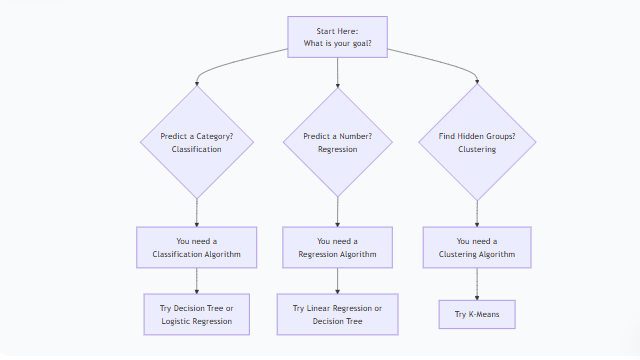
Now, let's open the toolbox and look at a few of the most common and useful tools. These are great starting points.
You need an algorithm that can draw a line between different groups.
Logistic Regression:This is your simple, reliable pencil. It's great for straightforward yes/no problems. "Will this student pass the exam?" or "Is this transaction fraudulent?" It's fast, easy to understand, and a fantastic first try. It won't handle super complex patterns, but it gets the job done most of the time.
Decision Tree:This is like playing a game of "20 Questions." Is the animal big? No. Does it have fur? Yes. Does it climb trees? Yes. It must be a squirrel! The algorithm asks a series of yes/no questions to sort your data. It's very easy to explain to someone else, which is a huge plus. The first time I used one, I was shocked at how clear the rules were.
You need an algorithm that can find the line that best fits your data.
Linear Regression:This is your classic ruler. It finds the straight line that best fits a set of points. If you're predicting something like "house price based on its size," this is your go-to. It assumes the relationship is a straight line, which is often a good enough place to start.
You need an algorithm that can find patterns without any labels.
K-Means:Imagine you have a pile of different LEGO bricks. K-Means is like telling a friend, "Please sort these into 3 piles that look similar." It will group the data into clusters where items in the same group are more alike. It's perfect for customer segmentation or organizing large collections of data you know nothing about.
The flowchart gets you 90% of the way there. But sometimes, you need to think about the finer details.
How Much Data Do You Have?Some algorithms, like big complex ones called Neural Networks, need tons of data to work well. Others, like our friend Logistic Regression, can do a lot with just a little.
How Fast Does It Need to Be?If you need an answer in a split second (like checking for credit card fraud), you'll pick a different tool than if you have all day to get a result.
Can You Explain It?Sometimes, you need to be able to show your work. A Decision Tree is easy to explain. Other "black box" models are powerful but can't tell youwhythey made a decision.
This is where some people decide tohire a machine learning engineer. An expert can help you fine-tune these choices and build something really special. It's like calling a master carpenter for a complex woodworking project.
A friend wanted to predict if her homemade bread would be good based on the room's temperature and how long it rose. She tried a complex algorithm first and failed. Then, she went back to the flowchart. She was predicting a category ("good" or "bad" bread), so she picked a simple Classification algorithm. It worked perfectly. Starting simple almost always wins.
So, here's the bottom line. Don't get overwhelmed by all the choices.
Look at your goal. Category, number, or groups?
Follow the flowchart to a starting point.
Try a simple algorithm first. You might be surprised how far it gets you.
The best way to learn is by doing. Why not find a small project and give it a try this weekend?
What is the easiest machine learning algorithm to start with?
Linear Regression for predicting numbers or Logistic Regression for predicting categories are the easiest. They are simple, fast, and teach you the core ideas without being too complicated.
What if my data has both numbers and categories?
This is very common. Many algorithms can handle this mix. A Decision Tree is a great choice because it doesn't care if it's asking about a number (is age over 30?) or a category (is color red?).
How do I know if my algorithm is working well?
You test it on new data it hasn't seen before. It's like studying for a test; you don't know if you've learned it until you take the real exam. If it does well on the "exam" data, it's working.
When should I hire an ai machine learning consultant?
If you've tried the basic steps and your project isn't working, or if the problem is very important to your business, it's a good time to call a pro. They help with advancedmachine learning algorithm selectionand building strong models.