A language model that only relies on its training data is like a person who stopped reading the news years ago. It can talk fluently, but its knowledge has a cutoff. It cannot tell you what happened last week. It cannot answer questions about your company's internal documents. And sometimes, it makes things up entirely because it has no way to check its facts.
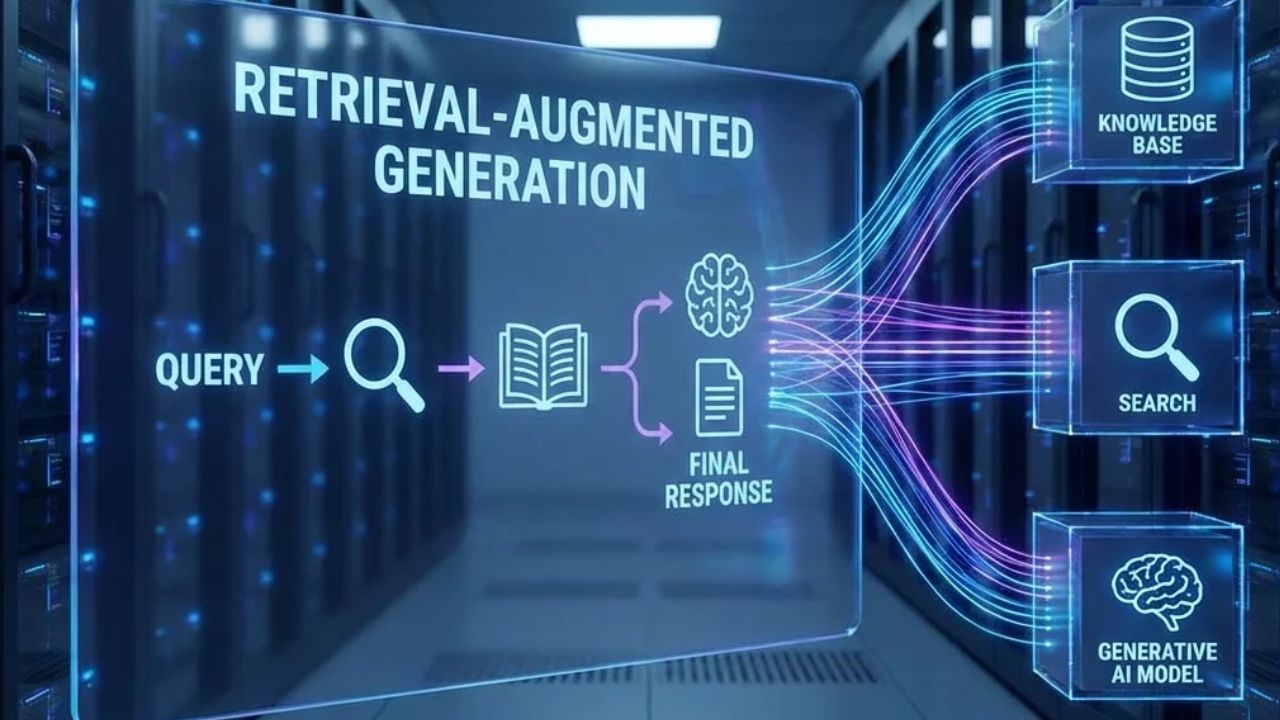
Retrieval Augmented Generation solves this problem. The term sounds technical, but the idea behind it is simple. Instead of asking the model to answer from memory alone, you first go find relevant information, hand it to the model, and then ask it to answer using that information. The model stops guessing and starts reading.
This article explains how that process works, step by step, without unnecessary complexity.
The Problem RAG Solves
Large language models are trained on enormous amounts of text. During training, they learn patterns, facts, and relationships between concepts. This training gives them a broad understanding of language and the world. But it also creates three limitations.
First, their knowledge is frozen at the point when training ended. A model trained in early 2024 knows nothing about events from late 2024. It has no awareness of new research, new products, or new developments in any field.
Second, they have no access to private or specialized information. A general model knows nothing about your company's internal policies, your customer contracts, or your proprietary research. It was never trained on those documents.
Third, and most dangerously, they hallucinate. When a language model does not know the answer, it does not always say so. Sometimes it generates a response that sounds confident and plausible but is factually wrong. This happens because the model is designed to produce fluent text, not to verify truth. It fills gaps with patterns that seem right, even when they are not .
RAG addresses all three problems. By retrieving real information and providing it to the model as context, RAG grounds the model's response in actual data. The model no longer relies solely on its training. It reads the retrieved information and uses that to form its answer .
Read Also: How Do Online Reputation Management Services in Dubai Help Businesses?
The Basic Workflow
At its core, RAG follows a simple pattern: retrieve relevant information, add it to the prompt, generate a response. But each of those steps involves important details that determine whether the system works well or produces poor results.
Step One: Preparing Your Knowledge Base
Before the system can retrieve anything, you need to build a searchable collection of information. This collection is often called a knowledge base. It might contain product documentation, internal reports, legal contracts, research papers, customer support tickets, or any other text you want the system to use.
The first task is breaking large documents into smaller pieces. This process is called chunking. A 50-page report is too large to feed into a model for every question. Instead, the system splits the report into chunks, which might be individual paragraphs, sections, or pages. The size of these chunks matters. Smaller chunks give more precise retrieval because each chunk focuses on a specific idea. Larger chunks preserve more context but make retrieval less precise .
There is no universal best chunk size. The right choice depends on the type of content. A legal document might benefit from paragraph-level chunks, while a technical manual might work better with section-level chunks. Some systems also create overlapping chunks, where the end of one chunk repeats at the start of the next, so context is not lost at the boundaries .
Once the text is divided into chunks, each chunk must be converted into a format that computers can search efficiently. This is where embeddings come in.
An embedding model takes a piece of text and converts it into a list of numbers, called a vector. This vector represents the meaning of the text in mathematical form. Texts that are similar in meaning produce vectors that are close together in this mathematical space. For example, the phrases "how to reset a password" and "steps to change my login credentials" would produce similar vectors even though they share few words, because they mean similar things .
All these vectors are then stored in a vector database. This is a specialized database designed to find vectors that are similar to a given query vector quickly, even when there are millions or billions of vectors stored .
Step Two: Retrieving Relevant Information
When a user asks a question, the system does not send that question directly to the language model. Instead, it first uses the question to search the knowledge base.
The user's question is converted into a vector using the same embedding model that processed the stored documents. Then the system searches the vector database for chunks whose vectors are most similar to the question's vector. This process is called similarity search. It finds pieces of text that are semantically related to what the user is asking about .
For example, if a user asks "What is our policy on remote work?", the system converts that question into a vector and finds document chunks that discuss remote work policies. It does not rely on matching keywords. It finds chunks that mean the same thing, even if they use different words .
The number of chunks retrieved is a tunable setting. Retrieving more chunks provides more context but also introduces more noise, because some retrieved chunks may be only loosely related to the question. Retrieving fewer chunks keeps the context focused but risks missing important information .
Step Three: Adding Context to the Prompt
Now the system has two pieces of information: the user's original question and a set of retrieved text chunks that are relevant to that question. The next step is to combine them into a single prompt that will be sent to the language model.
This prompt typically includes instructions telling the model to answer based on the provided context. The retrieved chunks are inserted into the prompt along with the user's question. The model is told, in effect: "Here is a question. Here are some relevant passages from our knowledge base. Use these passages to answer the question. Do not make things up. If the passages do not contain the answer, say so."
This step is called augmentation because the original prompt is augmented, or expanded, with additional information. The prompt that reaches the model contains far more than just the user's question. It contains the question plus the evidence needed to answer it .
Step Four: Generating the Answer
The augmented prompt is sent to the language model. The model reads the question and the retrieved passages, and it generates a response based on that information.
Because the model has relevant text right in front of it, it does not need to rely on its training data alone. It can quote from the retrieved passages, summarize them, or synthesize information across multiple chunks. The likelihood of hallucination drops significantly because the model is grounding its response in actual retrieved text .
Some RAG systems also ask the model to include citations, pointing back to the specific documents or chunks it used. This makes the answer verifiable. A user can check the source and confirm that the model's response is accurate .
Why This Approach Works
The effectiveness of RAG comes from a simple principle: it is easier to verify information than to recall it accurately. A language model cannot reliably remember every fact it was trained on. But it can read a passage and answer questions about that passage with high accuracy.
By retrieving relevant information and placing it in the model's context, RAG turns a recall problem into a reading comprehension problem. The model no longer needs to remember the answer. It only needs to understand the retrieved text and respond appropriately.
This is why RAG systems tend to produce more accurate responses than standalone language models, especially for questions that require specific or up-to-date knowledge . Research has consistently shown that grounding responses in retrieved evidence reduces hallucination rates and improves factual accuracy .
The Components That Make It Work
A RAG system is not a single model. It is a collection of components working together. Understanding what each component does helps clarify how the overall system functions.
The embedding model converts text into vectors. It is the bridge between human language and mathematical search. The quality of this model directly affects retrieval accuracy. A model that produces poor embeddings will retrieve irrelevant chunks, and the language model will then generate a poor answer .
The vector database stores and searches embeddings. It must handle similarity search efficiently, even with large collections of vectors. Different vector databases offer different trade-offs between speed, accuracy, and cost .
The retriever manages the search process. It takes the user's question, converts it to a vector, queries the database, and returns the most relevant chunks. Some retrievers use only vector similarity. Others combine vector search with traditional keyword search, which can improve results when exact terms matter .
The language model generates the final response. It receives the augmented prompt and produces an answer. The model's ability to follow instructions and use provided context determines how well it performs in a RAG system.
You May Also Like: What is green management? Why is it important in 2026?
What Can Go Wrong
RAG is powerful, but it is not magic. Several things can cause a RAG system to produce poor results.
If the knowledge base contains outdated or incorrect information, the system will retrieve that bad information and the model will use it. The output will be confidently wrong. Keeping the knowledge base accurate and current is essential .
If the retrieval step fails to find relevant chunks, the model will either answer from its training data, which may be outdated or incorrect, or it will say it cannot answer. Retrieval failures can happen because the chunks are poorly designed, the embedding model is weak, or the search parameters are not tuned correctly .
If too many chunks are retrieved, the prompt becomes cluttered with loosely related information. The model may get confused or focus on the wrong details. Precision matters as much as recall .
And even with good retrieval, the model can still make mistakes. It might misread a passage, combine information incorrectly, or generate a response that does not match the retrieved evidence. RAG reduces hallucination but does not eliminate it entirely .
RAG in Practice
You can see how RAG works in systems you might already use. A customer support chatbot that answers questions about product manuals uses RAG. It retrieves relevant sections from the manuals and uses them to form responses. A legal research tool that finds relevant case law uses RAG. It retrieves passages from legal databases and summarizes them for the attorney .
The pattern is the same across these applications. The system has a collection of documents it can search. When a question arrives, it finds the most relevant passages, hands them to a language model, and asks the model to answer based on those passages.
This approach is not limited to text. Some systems retrieve images, audio transcripts, or structured data. The underlying principle remains the same: find relevant information first, then generate a response that uses that information .
The Core Idea
Retrieval Augmented Generation works by separating two tasks that language models often struggle to combine: finding information and expressing it. The retrieval system finds the information. The language model expresses it. Neither component needs to do everything alone.
This separation is what makes RAG effective. It allows the system to access knowledge that the language model was never trained on. It allows that knowledge to be updated without retraining the model. And it grounds the model's responses in verifiable evidence, reducing the tendency to invent facts.
The next time you ask an AI assistant a question about a specific document and it gives you a precise answer with a citation, you will know what is happening behind the scenes. The system did not magically know the answer. It went and found the relevant information, handed it to the model, and the model read it and replied. That is Retrieval Augmented Generation.
 Thomas Hardy
A language model that only relies on its training data is like a person who stopped reading the news years ago. It can talk fluently, but its knowledge has a cutoff. It cannot tell you what happened last week. It cannot answer questions about your company's internal documents. And sometimes, it makes things up entirely because it has no way to check its facts.
Retrieval Augmented Generation solves this problem. The term sounds technical, but the idea behind it is simple. Instead of asking the model to answer from memory alone, you first go find relevant information, hand it to the model, and then ask it to answer using that information. The model stops guessing and starts reading.
This article explains how that process works, step by step, without unnecessary complexity.
The Problem RAG Solves
Large language models are trained on enormous amounts of text. During training, they learn patterns, facts, and relationships between concepts. This training gives them a broad understanding of language and the world. But it also creates three limitations.
First, their knowledge is frozen at the point when training ended. A model trained in early 2024 knows nothing about events from late 2024. It has no awareness of new research, new products, or new developments in any field.
Second, they have no access to private or specialized information. A general model knows nothing about your company's internal policies, your customer contracts, or your proprietary research. It was never trained on those documents.
Third, and most dangerously, they hallucinate. When a language model does not know the answer, it does not always say so. Sometimes it generates a response that sounds confident and plausible but is factually wrong. This happens because the model is designed to produce fluent text, not to verify truth. It fills gaps with patterns that seem right, even when they are not .
RAG addresses all three problems. By retrieving real information and providing it to the model as context, RAG grounds the model's response in actual data. The model no longer relies solely on its training. It reads the retrieved information and uses that to form its answer .
Read Also: How Do Online Reputation Management Services in Dubai Help Businesses?
The Basic Workflow
At its core, RAG follows a simple pattern: retrieve relevant information, add it to the prompt, generate a response. But each of those steps involves important details that determine whether the system works well or produces poor results.
Step One: Preparing Your Knowledge Base
Before the system can retrieve anything, you need to build a searchable collection of information. This collection is often called a knowledge base. It might contain product documentation, internal reports, legal contracts, research papers, customer support tickets, or any other text you want the system to use.
The first task is breaking large documents into smaller pieces. This process is called chunking. A 50-page report is too large to feed into a model for every question. Instead, the system splits the report into chunks, which might be individual paragraphs, sections, or pages. The size of these chunks matters. Smaller chunks give more precise retrieval because each chunk focuses on a specific idea. Larger chunks preserve more context but make retrieval less precise .
There is no universal best chunk size. The right choice depends on the type of content. A legal document might benefit from paragraph-level chunks, while a technical manual might work better with section-level chunks. Some systems also create overlapping chunks, where the end of one chunk repeats at the start of the next, so context is not lost at the boundaries .
Once the text is divided into chunks, each chunk must be converted into a format that computers can search efficiently. This is where embeddings come in.
An embedding model takes a piece of text and converts it into a list of numbers, called a vector. This vector represents the meaning of the text in mathematical form. Texts that are similar in meaning produce vectors that are close together in this mathematical space. For example, the phrases "how to reset a password" and "steps to change my login credentials" would produce similar vectors even though they share few words, because they mean similar things .
All these vectors are then stored in a vector database. This is a specialized database designed to find vectors that are similar to a given query vector quickly, even when there are millions or billions of vectors stored .
Step Two: Retrieving Relevant Information
When a user asks a question, the system does not send that question directly to the language model. Instead, it first uses the question to search the knowledge base.
The user's question is converted into a vector using the same embedding model that processed the stored documents. Then the system searches the vector database for chunks whose vectors are most similar to the question's vector. This process is called similarity search. It finds pieces of text that are semantically related to what the user is asking about .
For example, if a user asks "What is our policy on remote work?", the system converts that question into a vector and finds document chunks that discuss remote work policies. It does not rely on matching keywords. It finds chunks that mean the same thing, even if they use different words .
The number of chunks retrieved is a tunable setting. Retrieving more chunks provides more context but also introduces more noise, because some retrieved chunks may be only loosely related to the question. Retrieving fewer chunks keeps the context focused but risks missing important information .
Step Three: Adding Context to the Prompt
Now the system has two pieces of information: the user's original question and a set of retrieved text chunks that are relevant to that question. The next step is to combine them into a single prompt that will be sent to the language model.
This prompt typically includes instructions telling the model to answer based on the provided context. The retrieved chunks are inserted into the prompt along with the user's question. The model is told, in effect: "Here is a question. Here are some relevant passages from our knowledge base. Use these passages to answer the question. Do not make things up. If the passages do not contain the answer, say so."
This step is called augmentation because the original prompt is augmented, or expanded, with additional information. The prompt that reaches the model contains far more than just the user's question. It contains the question plus the evidence needed to answer it .
Step Four: Generating the Answer
The augmented prompt is sent to the language model. The model reads the question and the retrieved passages, and it generates a response based on that information.
Because the model has relevant text right in front of it, it does not need to rely on its training data alone. It can quote from the retrieved passages, summarize them, or synthesize information across multiple chunks. The likelihood of hallucination drops significantly because the model is grounding its response in actual retrieved text .
Some RAG systems also ask the model to include citations, pointing back to the specific documents or chunks it used. This makes the answer verifiable. A user can check the source and confirm that the model's response is accurate .
Why This Approach Works
The effectiveness of RAG comes from a simple principle: it is easier to verify information than to recall it accurately. A language model cannot reliably remember every fact it was trained on. But it can read a passage and answer questions about that passage with high accuracy.
By retrieving relevant information and placing it in the model's context, RAG turns a recall problem into a reading comprehension problem. The model no longer needs to remember the answer. It only needs to understand the retrieved text and respond appropriately.
This is why RAG systems tend to produce more accurate responses than standalone language models, especially for questions that require specific or up-to-date knowledge . Research has consistently shown that grounding responses in retrieved evidence reduces hallucination rates and improves factual accuracy .
The Components That Make It Work
A RAG system is not a single model. It is a collection of components working together. Understanding what each component does helps clarify how the overall system functions.
The embedding model converts text into vectors. It is the bridge between human language and mathematical search. The quality of this model directly affects retrieval accuracy. A model that produces poor embeddings will retrieve irrelevant chunks, and the language model will then generate a poor answer .
The vector database stores and searches embeddings. It must handle similarity search efficiently, even with large collections of vectors. Different vector databases offer different trade-offs between speed, accuracy, and cost .
The retriever manages the search process. It takes the user's question, converts it to a vector, queries the database, and returns the most relevant chunks. Some retrievers use only vector similarity. Others combine vector search with traditional keyword search, which can improve results when exact terms matter .
The language model generates the final response. It receives the augmented prompt and produces an answer. The model's ability to follow instructions and use provided context determines how well it performs in a RAG system.
You May Also Like: What is green management? Why is it important in 2026?
What Can Go Wrong
RAG is powerful, but it is not magic. Several things can cause a RAG system to produce poor results.
If the knowledge base contains outdated or incorrect information, the system will retrieve that bad information and the model will use it. The output will be confidently wrong. Keeping the knowledge base accurate and current is essential .
If the retrieval step fails to find relevant chunks, the model will either answer from its training data, which may be outdated or incorrect, or it will say it cannot answer. Retrieval failures can happen because the chunks are poorly designed, the embedding model is weak, or the search parameters are not tuned correctly .
If too many chunks are retrieved, the prompt becomes cluttered with loosely related information. The model may get confused or focus on the wrong details. Precision matters as much as recall .
And even with good retrieval, the model can still make mistakes. It might misread a passage, combine information incorrectly, or generate a response that does not match the retrieved evidence. RAG reduces hallucination but does not eliminate it entirely .
RAG in Practice
You can see how RAG works in systems you might already use. A customer support chatbot that answers questions about product manuals uses RAG. It retrieves relevant sections from the manuals and uses them to form responses. A legal research tool that finds relevant case law uses RAG. It retrieves passages from legal databases and summarizes them for the attorney .
The pattern is the same across these applications. The system has a collection of documents it can search. When a question arrives, it finds the most relevant passages, hands them to a language model, and asks the model to answer based on those passages.
This approach is not limited to text. Some systems retrieve images, audio transcripts, or structured data. The underlying principle remains the same: find relevant information first, then generate a response that uses that information .
The Core Idea
Retrieval Augmented Generation works by separating two tasks that language models often struggle to combine: finding information and expressing it. The retrieval system finds the information. The language model expresses it. Neither component needs to do everything alone.
This separation is what makes RAG effective. It allows the system to access knowledge that the language model was never trained on. It allows that knowledge to be updated without retraining the model. And it grounds the model's responses in verifiable evidence, reducing the tendency to invent facts.
The next time you ask an AI assistant a question about a specific document and it gives you a precise answer with a citation, you will know what is happening behind the scenes. The system did not magically know the answer. It went and found the relevant information, handed it to the model, and the model read it and replied. That is Retrieval Augmented Generation.