Honestly, this is one of the most common questions I see from people starting out, and the answer is a bit “it depends” — but I’ll try to break it down in a practical way.
If you’re coming from a non‑math background (like most of us), you don’t need to become a mathematician overnight. You do need to get comfortable with a few basic ideas, otherwise you’ll hit a wall when your model doesn’t work or when someone asks you “why did you choose this?”
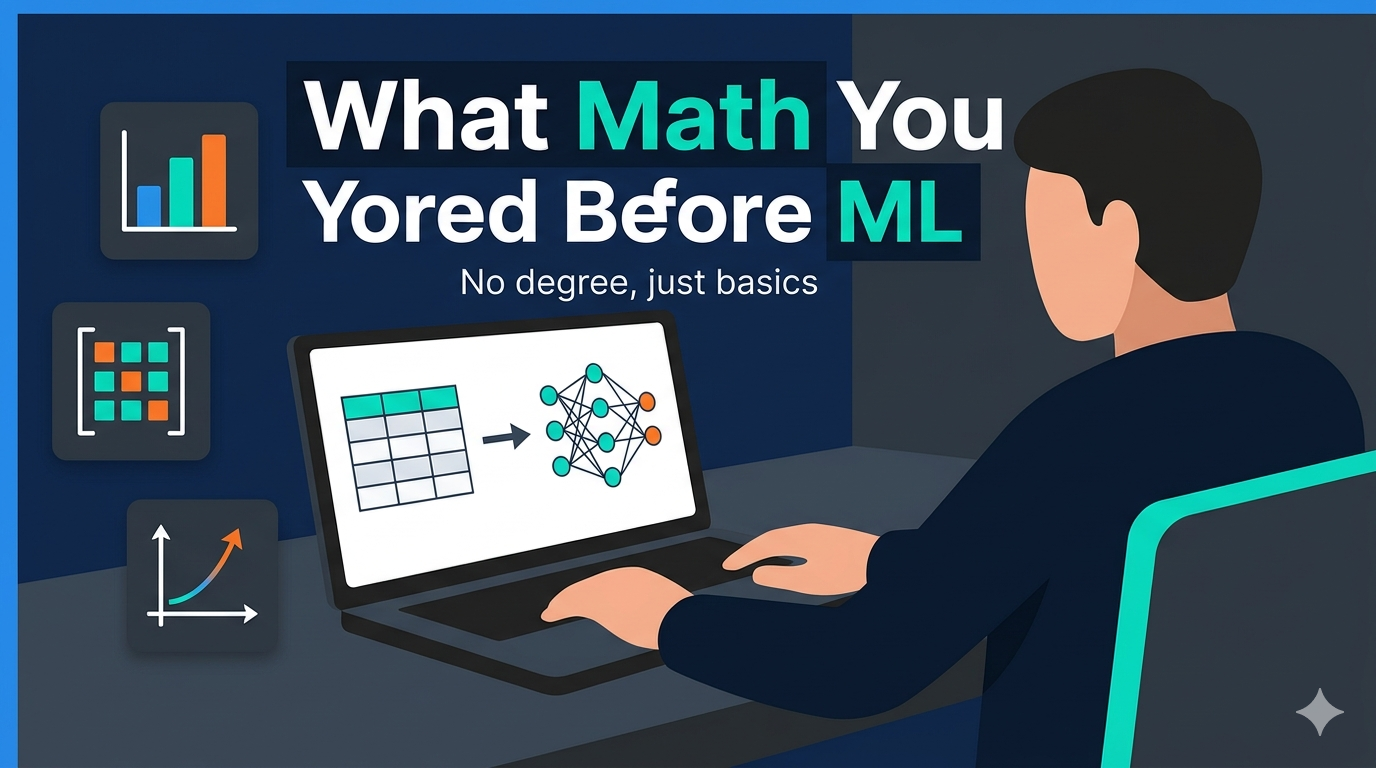
1. Start with basic stats and probability
The first thing that matters is statistics and probability. Not advanced stuff, just the basics.
You should at least be okay with:
Mean, median, standard deviation – how “spread out” your data is.
Histograms and distributions – what normal, skewed, or uniform data looks like.
Simple probability – like “if this feature is high, how likely is the outcome to be positive?”
Why this is important:
All ML models deal with uncertainty and noise.
If your model is 85% accurate, stats help you understand whether that’s actually good or just random.
Even if you’re using libraries like scikit‑learn, knowing a bit of stats helps you trust or challenge the results.
You don’t need to memorize formulas. You do need to be able to read a simple explanation and say, “Okay, the model is more confident when the numbers are in this range.”
2. Linear algebra: vectors and matrices, not proofs
Linear algebra sounds scary, but for ML you mostly need intuition, not exam‑style proofs.
Think of it like this:
Your data is usually stored as a table (rows = samples, columns = features).
In math terms, that’s a matrix; each row is a vector.
When the model runs, it’s doing operations on these matrices and vectors to combine your features into predictions.
You don’t need to derive eigenvalues or do advanced matrix theory unless you’re going into research. What helps is understanding:
What a dot product is (how features are combined with weights).
Why shapes matter (e.g., “why am I getting a shape mismatch error?”).
If you can visualize that your data is a table and your model is learning weights for each column, you’re already in a good place.
3. Calculus: gradients in plain language
You don’t need to do pen‑and‑paper calculus for most ML work. What you do need is a rough idea of gradients and how models learn.
Very simply:
A gradient tells you: “If I nudge this parameter up or down, how much will the error change?”
Gradient descent is the idea that the model takes small steps to reduce error, like walking downhill.
You never have to calculate gradients manually in TensorFlow or PyTorch — the library does it for you. But knowing that “learning rate = step size” and “gradients point to where the error increases” helps you understand why:
A learning rate that’s too high can overshoot.
A learning rate that’s too low takes forever.
Poorly scaled features can make the landscape weird and hard to optimize.
So, again, focus on intuition, not integrals.
4. What you can skip if you’re just starting
If your main goal is to use ML tools (scikit‑learn, Hugging Face, AutoML, etc.), and not build models from scratch, you can skip:
Heavy theoretical proofs.
Complex vector calculus.
Deep linear algebra unless you’re doing deep learning.
You can absolutely start building and using models with just:
Basic stats.
A rough idea of linear algebra (tables, vectors, multiplication).
A simple understanding of “the model learns by adjusting weights to reduce error.”
You’ll hit the math wall later when you want to debug models or choose between algorithms. That’s when you can go back and fill gaps.
5. How to learn this in a forum‑style way
Instead of sitting with a textbook for months, try this:
Pick a tiny project
Example: “Predict if a product will sell based on price and rating.”
Use a simple CSV and scikit‑learn.
After running the model, ask “why?”
“Why is accuracy 80%?”
“What do the coefficients mean?”
“How does changing the data affect the result?”
Only learn math when you’re stuck
If you don’t understand “gradient descent,” watch one short video or read one explanation.
If you’re confused about “feature scaling,” quickly look up standard deviation and normalization.
Use beginner‑friendly resources
Look for tutorials that explain stats or linear algebra in the context of real code.
Avoid heavy theory‑only books unless you specifically want to dive deep.
6. Simple “enough?” checklist
Ask yourself:
Can I explain in plain language what mean, standard deviation, and a histogram tell me about my data?
Do I understand that a matrix is basically a table of data?
Can I say in simple terms how changing a weight affects the model’s output?
Can I read a basic formula like y = w1*x1 + w2*x2 + b and explain it out loud?
If you’re mostly nodding “yes,” you’re in a good spot. You can always deepen your math later as you get more serious.
Read Also : Claude Pro Out of Messages: What It Means and Fixes
 Matti Karttunen
Honestly, this is one of the most common questions I see from people starting out, and the answer is a bit “it depends” — but I’ll try to break it down in a practical way.
If you’re coming from a non‑math background (like most of us), you don’t need to become a mathematician overnight. You do need to get comfortable with a few basic ideas, otherwise you’ll hit a wall when your model doesn’t work or when someone asks you “why did you choose this?”
1. Start with basic stats and probability
The first thing that matters is statistics and probability. Not advanced stuff, just the basics.
You should at least be okay with:
Mean, median, standard deviation – how “spread out” your data is.
Histograms and distributions – what normal, skewed, or uniform data looks like.
Simple probability – like “if this feature is high, how likely is the outcome to be positive?”
Why this is important:
All ML models deal with uncertainty and noise.
If your model is 85% accurate, stats help you understand whether that’s actually good or just random.
Even if you’re using libraries like scikit‑learn, knowing a bit of stats helps you trust or challenge the results.
You don’t need to memorize formulas. You do need to be able to read a simple explanation and say, “Okay, the model is more confident when the numbers are in this range.”
2. Linear algebra: vectors and matrices, not proofs
Linear algebra sounds scary, but for ML you mostly need intuition, not exam‑style proofs.
Think of it like this:
Your data is usually stored as a table (rows = samples, columns = features).
In math terms, that’s a matrix; each row is a vector.
When the model runs, it’s doing operations on these matrices and vectors to combine your features into predictions.
You don’t need to derive eigenvalues or do advanced matrix theory unless you’re going into research. What helps is understanding:
What a dot product is (how features are combined with weights).
Why shapes matter (e.g., “why am I getting a shape mismatch error?”).
If you can visualize that your data is a table and your model is learning weights for each column, you’re already in a good place.
3. Calculus: gradients in plain language
You don’t need to do pen‑and‑paper calculus for most ML work. What you do need is a rough idea of gradients and how models learn.
Very simply:
A gradient tells you: “If I nudge this parameter up or down, how much will the error change?”
Gradient descent is the idea that the model takes small steps to reduce error, like walking downhill.
You never have to calculate gradients manually in TensorFlow or PyTorch — the library does it for you. But knowing that “learning rate = step size” and “gradients point to where the error increases” helps you understand why:
A learning rate that’s too high can overshoot.
A learning rate that’s too low takes forever.
Poorly scaled features can make the landscape weird and hard to optimize.
So, again, focus on intuition, not integrals.
4. What you can skip if you’re just starting
If your main goal is to use ML tools (scikit‑learn, Hugging Face, AutoML, etc.), and not build models from scratch, you can skip:
Heavy theoretical proofs.
Complex vector calculus.
Deep linear algebra unless you’re doing deep learning.
You can absolutely start building and using models with just:
Basic stats.
A rough idea of linear algebra (tables, vectors, multiplication).
A simple understanding of “the model learns by adjusting weights to reduce error.”
You’ll hit the math wall later when you want to debug models or choose between algorithms. That’s when you can go back and fill gaps.
5. How to learn this in a forum‑style way
Instead of sitting with a textbook for months, try this:
Pick a tiny project
Example: “Predict if a product will sell based on price and rating.”
Use a simple CSV and scikit‑learn.
After running the model, ask “why?”
“Why is accuracy 80%?”
“What do the coefficients mean?”
“How does changing the data affect the result?”
Only learn math when you’re stuck
If you don’t understand “gradient descent,” watch one short video or read one explanation.
If you’re confused about “feature scaling,” quickly look up standard deviation and normalization.
Use beginner‑friendly resources
Look for tutorials that explain stats or linear algebra in the context of real code.
Avoid heavy theory‑only books unless you specifically want to dive deep.
6. Simple “enough?” checklist
Ask yourself:
Can I explain in plain language what mean, standard deviation, and a histogram tell me about my data?
Do I understand that a matrix is basically a table of data?
Can I say in simple terms how changing a weight affects the model’s output?
Can I read a basic formula like
y = w1*x1 + w2*x2 + band explain it out loud?If you’re mostly nodding “yes,” you’re in a good spot. You can always deepen your math later as you get more serious.
Read Also : Claude Pro Out of Messages: What It Means and Fixes